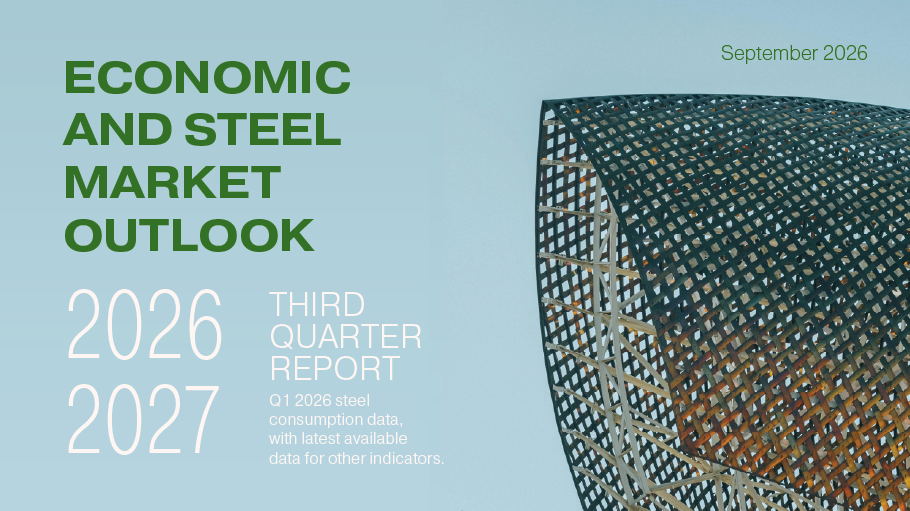
PRESS RELEASE » Economic and Steel Market Outlook 2026-2027: Q3 Press Release
Economic and Steel Market Outlook 2026-2027: EU steel exports fall 20% as demand outlook remains flat
Downloads and links
Recent updates
Brussels, 1 October 2026 - Europe’s steel market remains under significant pressure, with exports falling sharply, production at historic lows and demand expected to remain almost flat in 2026, according to the European Steel Association’s (EUROFER) latest Economic and Steel Market Outlook 2026-2027. EU steel exports to third countries fell by 20% in the first half of 2026, with declines across all major export destinations covered by the report. At the same time, crude steel production continued to falter, after reaching a historic low of 125.8 million tonnes in 2025, while apparent steel consumption is forecast to grow by just 0.1% in 2026, before increasing by 2.3% in 2027.
Axel Eggert, EUROFER’S Director-General remarked, “The 20% fall in exports is an alarming signal of the pressure facing European steel. Combined with production at historic lows and persistently high energy costs, it shows that Europe’s industrial recovery is far from secured. The new EU steel trade measure is an essential first step. Now we need to build on that progress with an industrial recovery that works across regions and across the value chain, bringing back production, investment and quality jobs in Europe.”
Steel production remains at historic lows
EU crude steel production fell by 2.9% to a record low of 125.8 million tonnes in 2025 and declined by a further 1% in the first five months of 2026 (+1.1% in May 2026). Capacity utilisation improved slightly to 67% from 65% in 2025, but remains low in historical terms.
Steel exports fall sharply
EU steel exports to third countries fell by 20% in the first six months of 2026. Exports declined across major international markets, including the United States (-29%), India (-24%), Turkey (-21%) and China (-18%). Despite a decline in imports over the same period, the EU remains a significant net importer of steel.
Steel demand loses momentum
Apparent steel consumption increased by 1.5% in the first quarter of 2026, but the recovery is expected to lose momentum. Growth is forecast at just 0.1% for the year. A more meaningful improvement is expected in 2027, when demand is forecast to grow by 2.3%, with consumption remaining around 7 million tonnes below 2019 levels.
Industrial demand recovers only modestly
Output in steel-using sectors is forecast to grow by 1.5% in 2026, following two years of decline. The recovery remains uneven: construction and mechanical engineering are expected to support growth, while automotive output is forecast to fall by a further 0.9%. A broader recovery is not expected before 2027.
Energy and global uncertainty continue to weigh on industry
Energy costs have risen sharply during 2026, adding further pressure on Europe’s energy-intensive industries. European gas prices have fluctuated around €50/MWh, reaching peaks of around €80/MWh in recent weeks - 132% higher than at the start of the year. The renewed increase in energy prices is weighing on industrial competitiveness at a time when manufacturing activity remains fragile.
Read the full Economic and Steel Market Outlook 2026-2027 here.
Contact
David French, Spokesperson and Head of Communications, +32 2 738 79 35, (d.french@eurofer.eu)
About the European Steel Association (EUROFER)
EUROFER AISBL is located in Brussels and was founded in 1976. It represents the entirety of steel production in the European Union. EUROFER members are steel companies and national steel federations throughout the EU. The major steel companies and national steel federation of Turkey, Ukraine and the United Kingdom are associate members.
The European Steel Association is recorded in the EU transparency register: 93038071152-83.
About the European steel industry
The European steel industry is a world leader in innovation and environmental sustainability. It has a turnover of around €215 billion and directly employs around 298,000 highly-skilled people, producing on average 146 million tonnes of steel per year. More than 500 steel production sites across 22 EU Member States provide direct and indirect employment to millions more European citizens. Closely integrated with Europe’s manufacturing and construction industries, steel is the backbone for development, growth and employment in Europe.
Steel is the most versatile industrial material in the world. The thousands of different grades and types of steel developed by the industry make the modern world possible. Steel is 100% recyclable and therefore is a fundamental part of the circular economy. As a basic engineering material, steel is also an essential factor in the development and deployment of innovative, CO2-mitigating technologies, improving resource efficiency and fostering sustainable development in Europe.
Proposed credit would allow European carmakers to meet 3% of their CO₂ targets through low-carbon steel made in the EU rising to 7.5% from 2035.
Brussels, 21 October 2026 - The European steel industry welcomes a compromise reached in the European Parliament yesterday on CO₂ standards for cars and vans, which includes a dedicated incentive for carmakers to use low-carbon steel Made in the EU.
As EU steel production rises, helping preserve up to 80,000 jobs, the industry reports €3.4 billion in investment decisions, with a further €2.4 billion expected by year-end.
Brussels, 1 October 2026 - The European Steel Association (EUROFER) has elected Geert Van Poelvoorde, Chairman of the Board of ArcelorMittal Europe Steel, as its new President. Taking office today, Mr Van Poelvoorde said stronger home markets across the steel value chain, secure access to export markets and a strong industrial base will be essential to delivering on the European Union’s ambitions for global competitiveness and strategic autonomy.
The European Steel Association (EUROFER)
172 Avenue de Cortenbergh
1000 Brussels
Belgium
Email: mail@eurofer.eu
Phone: +32 (0) 2 738 79 20